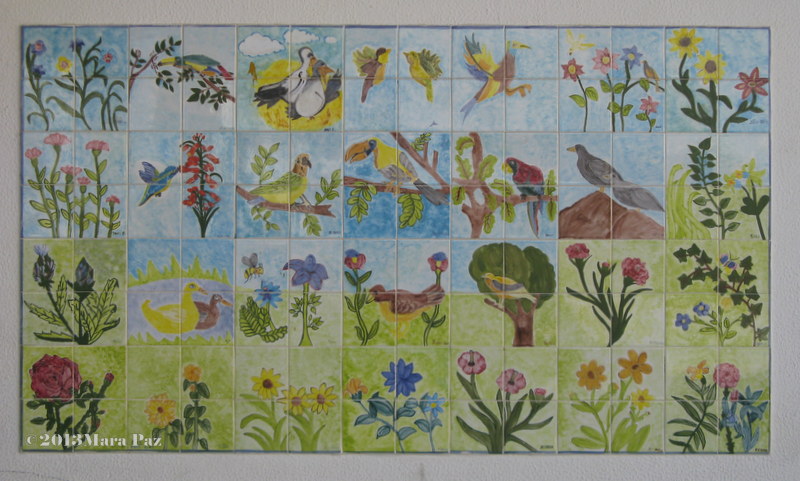
This ceramic panel is my choice for the interpretation of FANTASY, Jake's Sunday post prompt for today. Click on the horse and you'll be transported on a FANTASY tour.
Showing posts with label azulejo. Show all posts
Sunday, January 19, 2014
Fantasy
This ceramic panel is my choice for the interpretation of FANTASY, Jake's Sunday post prompt for today. Click on the horse and you'll be transported on a FANTASY tour.
Sunday, March 10, 2013
Arrangement
| Simple geometrical arrangement |
| Birds and flowers arrangement |
| Elaborate arrangement with sea creatures as the theme |
| Typical houses and trees arrangement |
All this artwork on ceramic tiles was made by young students at an Algarve school (with expert guidance from their teacher, of course).
I hope you like my selection of arrangements. For more, visit Jake's.
Labels:
Algarve,
arrangement,
azulejo,
birds,
ceramic tiles,
flowers,
sea,
Sunday post,
trees
Friday, August 17, 2012
Sight-seeing in Porto
Porto is lovely in the summer. For those of my readers who live in the Algarve, why not do like me and go north to avoid the extreme heat and tourist overload in August, down south. Taking the train is a good alternative to the car or the coach. If you decide to drive up, it will take you around 6 hours by motorway to reach Porto (allowing for coffee stops and keeping within the legal speed limit).
Every year I look forward to at least 2 weeks away from the overcrowded Algarve. This year I decided to explore the historical centre of the country's second largest city. Yesterday I ended my post as I was arriving at "Avenida dos Aliados" (Avenue of the Allies) and the "Praça da Liberdade" (Liberty Square), which is considered the heart of the city.
| A kiosk at the beginning of the Avenue |
| A sculpture (forefront) and the Town Hall at the top of Liberty Square |
| Another sculpture |
| Statue of King Pedro IV |
| The Bank of Portugal |
Some of the buildings on the right:
Having almost filled my memory card and changed the overworked batteries in the camera, I moved on to the train station, which is nearby.
| Congregados Church, on the way to the train station |
| Part of the train station, as seen from the Square |
If you like tiled panels, this is tiled-panel heaven. I didn't take photos of every panel because I walked in with my pet. Carrying a dog and taking pics doesn't work too well, but you get the general idea.
| Part of "azulejo" heaven |
| Another part of "azulejo" heaven |
| Yet another part of "azulejo" heaven |
By this time I had been walking for over two hours, so I made my way up Clerigos Street and back to the narrow street where I had left my car.
| Clerigos Church at the top of Clerigos Street |
My tour of the historical centre is not complete but I hope I have whetted your appetite!
If architecture is not your thing, you'll be pleased to know that the last post in this series will focus on other things I found interesting.
Related posts:
I'm the great pretender tourist
Uma turista no Porto - 1
Thursday, June 7, 2012
Table Mountain
I've visited Cape Town on only 2 occasions, to visit my best friend from childhood.
Although I can't say that I have travelled the world, in my opinion it has to be the most beautiful city on earth. Lots of people probably share my opinion. I bet the owners of the house who had this picture of Table Mountain immortalised on "azulejo" and placed on the facade would agree with me.
| Table Mountain on "azulejo" |
To my surprise, I spotted this on the facade of a town house in Espinho, Portugal.
And here is a photo of that incredible mountain, taken on a cloudy day in 1998, from Bloubergrand (I think).
![]() |
| Off for a quick swim, or maybe not... |
I'm sure you have a favourite city. Tell me about it, won't you?
Wednesday, May 30, 2012
The wonders of Picasa!
A friend of mine introduced me to Picasa just before I started my blog and for that I'm very grateful. It really is very useful for a blogger. I don't have Photoshop and I'm not very tech savvy so I began exploring the possibilities of Picasa slowly.
The other day I was trying to organise my photos on Picasa and I discovered a detail that had been eluding me.
I have to confess that there are days when I'm really focused and others when I feel scatterbrained. When I began my teaching career, a colleague of mine said the stress of the job meant we'd be a bit potty by the age of fifty. As I've passed that age and entered the menopause, I try to tell myself that being scatterbrained is natural and I've began trying to stay organised and write things down a lot so that I don't forget them. (I used to have the memory of an elephant.)
However, on some days there is a simple reason for not paying enough attention to some details. One such day was when I took photos in Alcácer do Sal, after a long drive. It was hot, I was tired, so I didn't SEE everything that was there and then wasted time looking for the information that I wanted on the net, without success.
Fortunately, this week I decided to organise my photos, fiddled with one particular photo I hadn't used on my blog post and hey presto! I can now reveal the names of the creators of that beautiful ceramic panel - and I have Picasa to thank for that!
At one end of that panel there is something that initially looked like graffiti to me... but it isn't.
| Amplified on Picasa |
I can finally say thank you to Rute Soares and Inês Coimbra, who did those magnificent drawings that were turned into "azulejo" at a factory called Mosaicos Ideal, located in Alcântara, Lisbon.
All I need now is to find out the date. Can anyone help?
Related posts:
Wednesday, May 23, 2012
Scenes from Alcácer - on "azulejo" - 2
I'm hoping you aren't bored to death hearing about "azulejos".
Today is the final post in this series and I'm going to focus on the images of man-made features from that panel of ceramic tiles I photographed in Alcácer do Sal. You can see more images in my previous posts here (nature) and here (people at work).
The town has a beautiful castle.
King D. Afonso Henriques first conquered it from the Arabs in 1158. However, the Arabs took it back some years later and it was only reconquered in 1217.
Classified as a national monument, it now has a hotel, the Pousada D. Afonso II, inside its walls.
Close-up of a typical house - whitewashed walls with blue frames painted around the doors and windows.
I didn't know exactly what this was until one of my Portuguese readers who lives in the town sent me an informative message on Facebook. This is a traditional house made of straw from the rice plants. If you go to Carrasqueira, about 35 km from Alcácer, you can still see houses like this one.
Lovely elaborate chimneys, like in the Algarve.
Church towers - there are a few lovely ones in the town.
I would love to have more information about the artist who created this work of art and know when this panel was built. I have tried to find information on the internet but haven't found anything so far.
To end this series of posts, here is the town's coat of arms.
I'm glad I made a detour on my way to the Algarve - Alcácer do Sal and the surrounding area is definitely worth a visit.
Thursday, May 17, 2012
Scenes from Alcácer - on "azulejo" - 1
The cork oak landscape is a characteristic of the Alentejo region.
I didn't see any sunflowers but then I didn't have a lot of time to explore.
From the IC1 road I did see extensive fields of cereals.
I wish I had seen flamingos because they are such beautiful creatures. I will have to visit the Santo André Lagoon for that (50 km to the southwest).
And dolphins, well I didn't see any but they can be seen in the estuary of the Sado River, less than 50 km away to the northwest.
| Cork oaks in the Alentejo countryside |
| Sunflowers |
| Wheat |
| Flamingos |
| Dolphins |
I have only seen dolphins swimming along the beach between Armação de Pêra and Albufeira, though. I cannot prove it because I didn't have my camera, but it was a very special day for me.
Believe it or not, I have not finished with this panel of azulejos, but that is enough for today.
Sunday, May 13, 2012
Work
On a Sunday, how do I come up with a post about Work, which is the theme for the Sunday post challenge set by Jake this week?
Well, my still small photo collection has come to the rescue.
While exploring the town of Alcácer do Sal, I came upon a panel of ceramic tiles along one of the main roads, Avenida José Saramago. It is a very long panel depicting some traditional features, animals and activities from this area of the Alentejo.
Today I am just going to focus on the images of people at work.
Many people used to work on the production of salt, extracting it from sea water, as the name of the town suggests - Alcácer do Sal (do Sal = of the salt).
| Working on the production of salt. |
Fishing was and still is a very important activity.
| Fisherman at work. |
| Traditional fish seller. |
The Alentejo is well-known for its cork oak trees. The cork (outer bark) must be removed every 9 years and regenerates itself. Cork is used to make cork stoppers among other things.
| Removing the bark from the cork oak tree. |
The Alentejo is also known as the "breadbasket of Portugal" due to its cereal production.
Labels:
Alentejo,
azulejo,
ceramic tiles,
Sunday post,
work
Subscribe to:
Posts (Atom)